Create More, Consume Less: Reclaiming Focus in the Advertising Industry. An exploration of how implementing focus, flow, and deep work strategies allow advertisers to maximize productivity and produce high-quality, creative work.
In writing a white paper that reflects on the advertising industry’s loss of productivity when it comes to unintentional scrolling, I discovered as an advertiser myself, that I’ve lost way too much time scrolling too. In order to reach our full potential, and produce engaging, goal-driven, meaningful work, we must attack these poor scrolling habits that keep us coming back to social media as a distraction, and not a tool. The way to reclaim our attention relies in addressing the concerns head on, looking at the facts, and both strategizing and implementing focus and deep work methods that will allow us to reach flow, a passage of uninterrupted time devoted to creating meaningful work.
The Facts
After breaking a period of focus, it takes your brain over twenty three minutes to totally refocus on the intended task. So, imagine constant noise: emails, notifications, messages, and everything else distracting, pulling you away from accomplishing your work. It is difficult to distinguish when advertisers are using digital platforms as research versus when it becomes a distraction. My white paper looks into the negative outcomes of this constant noise and digital culture that promotes quick responses and constant task switching. When we can’t properly focus, we can’t correctly and creatively complete a task.
The Solution
Implementing focus, flow, and deep work strategies allow us restrict our digital over consumption and create intentionally and creatively. If we are constantly being fed content, it is challenging to think uniquely and creatively, two key frameworks of advertising and agency work. So, when we apply focus and deep work strategies, we can reach flow.
Flow: a mental state of complete absorption, energized focus, and enjoyment where a person becomes fully immersed in an activity.
Scheduling focus-blocks, periods that are solely used to work, without any noise, taking true rest breaks, and designing work for flow all aid us in the process of working creatively and authentically. When we feel we can accomplish a task, and are truly locked-into the content, we are motivated, attentive, and innovative, producing high-quality work.
Try out these strategies. You never know what they’ll lead to you producing.
I’ve written a lot about the reasons why our collective attention is slipping, and how we can recover it, but that isn’t possible if we don’t address the biggest stressor: stress.
So, we’ve discussed the greater system at large, cruel optimism and our own willpower, and social media’s addictive nature. We know we can make individual changes that allow us to reclaim our focus and time, but more importantly, we know we must break down the harmful system at play to truly reclaim our attention. To improve our ability to focus, we have to attack that system, the one that contributes to chronic stress, sleep deprivation, financial hardship, and digital distractions. When we change those practices, we can create conditions that promote healthier screen habits and better our sustained attention.
Stress & Attention’s Relationship
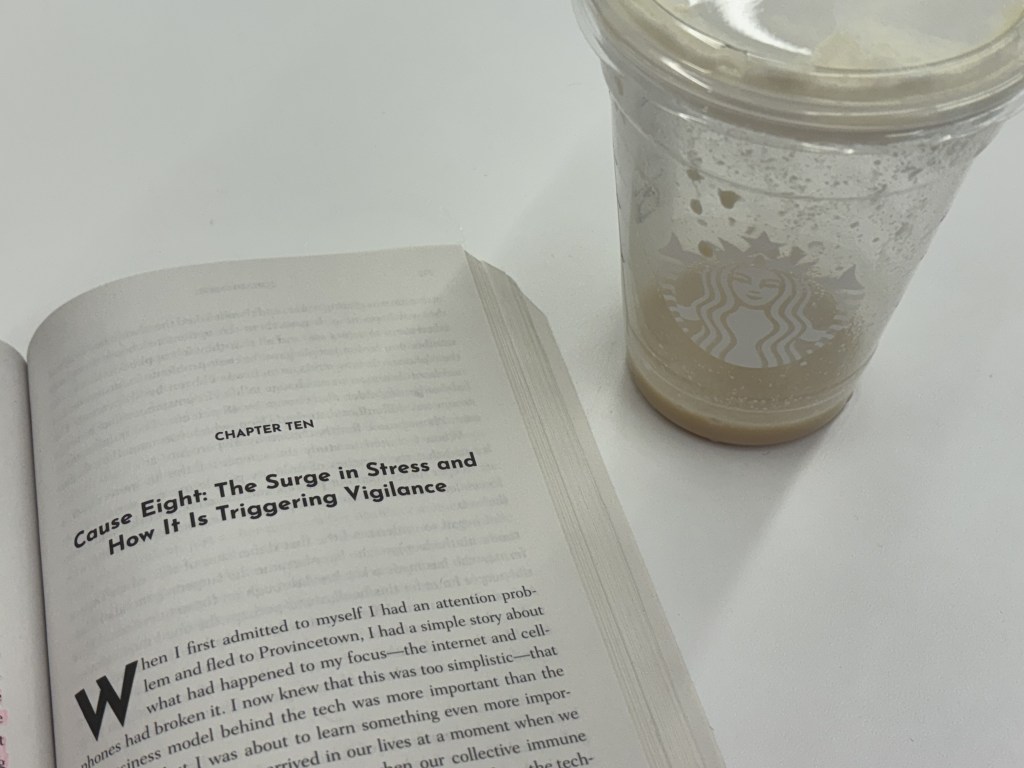
We can intertwine Johann Hari’s work and research from Stolen Focus into the argument.
Hari explores how our declining attention spans are a result of modern life’s growing societal pressures. The rise of the internet in the 90s, coincided with the collapse of the middle class, rising economic insecurity, and declining sleep habits, leaving people at extremely vulnerable states to experience stress and distraction.
At this point, everyone is aware that technology is a huge culprit for our inability to focus, but it’s not solely to blame. When we’re overwhelmed by financial struggle, aren’t sleeping enough, and constantly stressed about our futures and the world around us, we can’t properly focus.
A Pew Research article, Psychological Stress and Social Media Usage, states that, “There is more information flowing into people’s lives now than ever — much of it distressing and challenging.” Social media gives us a space to connect and find community, but it is always flowing, and that means it pushes distressing news about our governments, wars, climate crises, and everything else that induces stress. Seeing those things make me feel hopeless, and then imagine if it’s directly effecting you. That would induce a lot of stress wouldn’t it.
Finding Leverage Points
A leverage point is the place within a complex system where a small shift in one thing can produce bigger changes in everything.
In a Donna Meadows Project article, Leverage Points: Places to Intervene in a System, Meadows explains that “leverage points are points of power”, and can be used when correcting broken systems, systems that need to be designed for the public good. Instead of treating the symptoms of the problem, we should identify the structure that caused it. So, when we approach the attention crisis, we blame it on the individual, telling them to disconnect, spend more time outside, and practice mindfulness. Yes, doing all of that does help, but placing the responsibility on just the individuals doesn’t achieve much. Tech companies are continuing to design platforms that capture our attention, “fixated on economic growth as the answer to virtually all problems”, workplaces push for constant productivity, and financial burdens leave individuals stressed out more than ever, with less time to properly rest.
When productivity and profit are the priority, our creativity and attention are neglected from the resulting stress, yet society still expects us to perform at our best.
Fixing the Broken System
If we want to reclaim our attention, we’ve got to consider changes beyond personal habits, and start demanding systematic shifts. Thinks about those leverage points. We need healthier workplace expectations, greater financial security, and technology that is actually designed from the perspective of promoting human well-being. Let’s consider who set these systems up, what their defining interests are, and who has the power to change them. We can’t promote cruel optimism, we have to be realistic, and attack the structure that rewards engagement, overwork, and over-productivity.
We just have to find one way in, one minor change that will lead to major changes.
I’m ready to demand better. Because we deserve it. If we do it collectively, then anything is possible.
Social media was destroying my ability to be present.
Three weeks ago, I completed a five day digital detox from TikTok. I haven’t returned to the platform since. Here’s what I’ve learned, and why I haven’t gone back.
In the pursuit of understanding and redefining my relationship with social media, I experimented with removing my ultimate attention weakness: TikTok. What began as a five-day experiment has turned into a complete lifestyle change. I used to waste 1 hour and 37 minutes on TikTok everyday, now I spend 0 minutes every week, and I feel great.
What I’ve Learned
Social media is addictive. That’s a fact. Not just a feeling.
Social media platforms are designed to keep you scrolling. Every click, comment, or interaction keeps you engaged, and caught in an endless cycle.
But It wasn’t always this way. I can recall being a kid, first introduced to Musical.ly, and falling in love with the concept of creating. Social media used to spark my creativity; I’d make dance challenges with friends, lip syncing duets, or short film productions. Now, all it does is leave me saving creative inspiration to my saves folder, collecting dust next to the other 652 videos saved, and to never return to them.
There’s a reason scrolling keeps you hooked: every scroll is unpredictable. When your brain sees an interesting video, it’s reward system is triggered to release dopamine, which is involved with learning and anticipating rewards. Since scrolling is unpredictable, you keep scrolling to see what’s coming next, enforcing this habitual behavior.
According to the Addiction Center, a 2022 study found that TikTok is the most highly addictive of all social media platforms. TikTok steady flow of content distorts user’s sense of time keeping them “caught in an entertainment spiral.”
And don’t even get me started on algorithms.
Removing TikTok didn’t necessarily solve this addiction problem. Instead of scrolling on TikTok, I scrolled on Instagram, and started using Snapchat again, an app I never use. I still felt that itch to pick up the phone and scroll, now I had a different medium.
I can confidently say, I spend less time scrolling and more time noticing the world around me. My attention has improved and I no longer feel the urge to pick up my phone anytime I’m bored, uncomfortable, or avoiding a task.
Why I Haven’t Gone Back
Before the detox, I would spend 24.5 days of every year scrolling on just TikTok. I didn’t even want to think about how much time altogether I spent scrolling on social media. But I did, and I calculated it.
My average screen time is 4 hours and 53 minutes everyday.
When I factored in my age and the average expected lifetime I concluded that I’d spend 12.3 years of my remaining lifetime on my phone. Wow. That’s 1.4 days every week, 6 days every month, and 75 days every year. That was a wake up call, and I couldn’t ignore it not matter how hard I tried.
Test it yourself: calculate your screen time here and see how many months of your life you actually have left to truly live.
And that is exactly why I haven’t gone back to TikTok. I want to fully experience my life, being present, and not just caught in an entertainment spiral.
If I can make one positive change, removing TikTok, then I can keep making positive changes. I hope one day I can proudly say I spend 1 hour a week on social media, and it starts with one small change.
A exploration of project management and achieving total organization.
I’m type B.
I’ve got type A tendencies that’ll appear every so often, but overall, type B. That means I’ve always struggled with keeping my thoughts and tasks organized. Don’t get me wrong – I love a good calendar, I love checklists, and I love planning – when it’s not my professional life. When it comes down to creating a functional and repeatable system to organize both school assignments and work tasks, things become difficult for me.
So, I’ve decided it’s time to make a change and try exploring new ways, via the world of project management.
A Full Factory Reset
In the past, I’ve used agendas, digital docs, calendars, and an endless plethora of organization tools that never stuck. What I hadn’t had much experience with until recently was digital project management tools, such as Asana. Over the summer, I was introduced to Asana and it’s applications when working at a digital marketing agency. During that experience, I felt on track with deadlines and had clear expectations of what to prioritize and how my work week would look.
A key implication: I was on the receiving end of tasks. I completed projects that were assigned to me from the Digital Marketing Lead. I was not managing, I was being managed.
So, what’s the difference between following an organization’s established project management structure versus building and organizing your own project management system? Surprisingly a lot. It would require a full reset of how I create, organize, and achieve my goals through project management.
Divide and Conquer
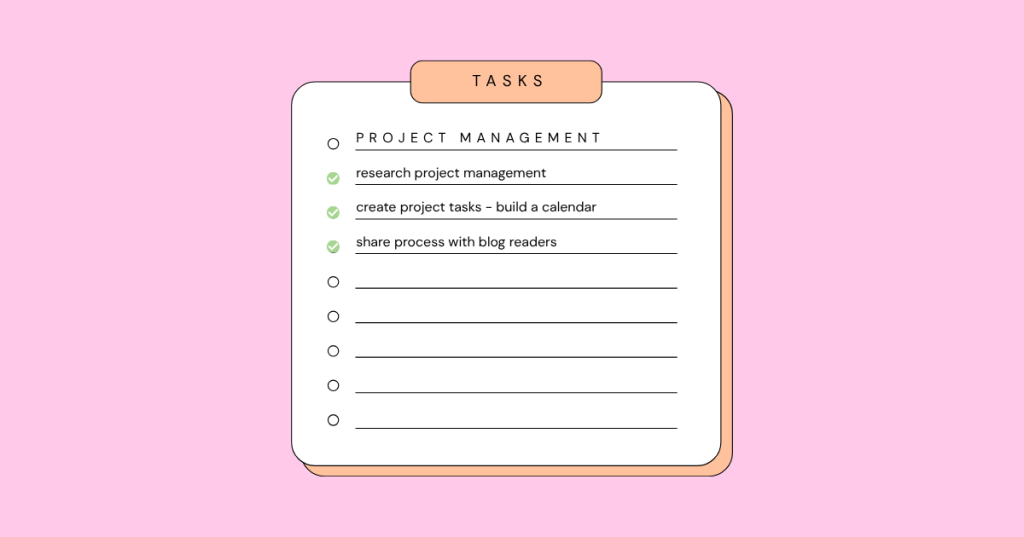
I appreciate a checklist.
Work feels approachable when I have everything I need to do written in one place, and organized into categories: graduate studies, internship work, undergraduate studies, and organizational needs.
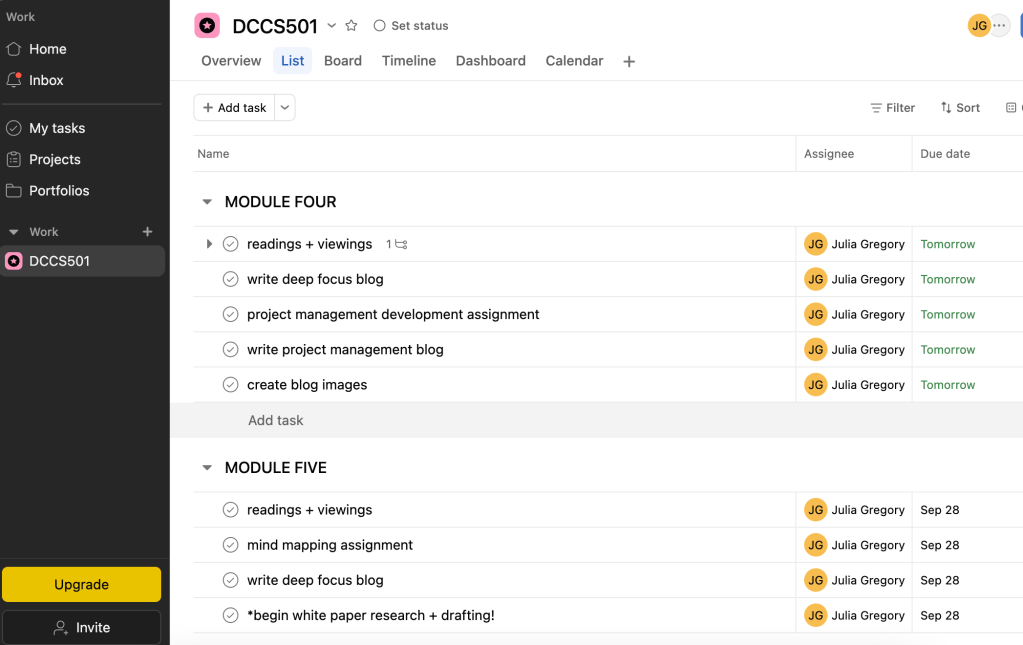
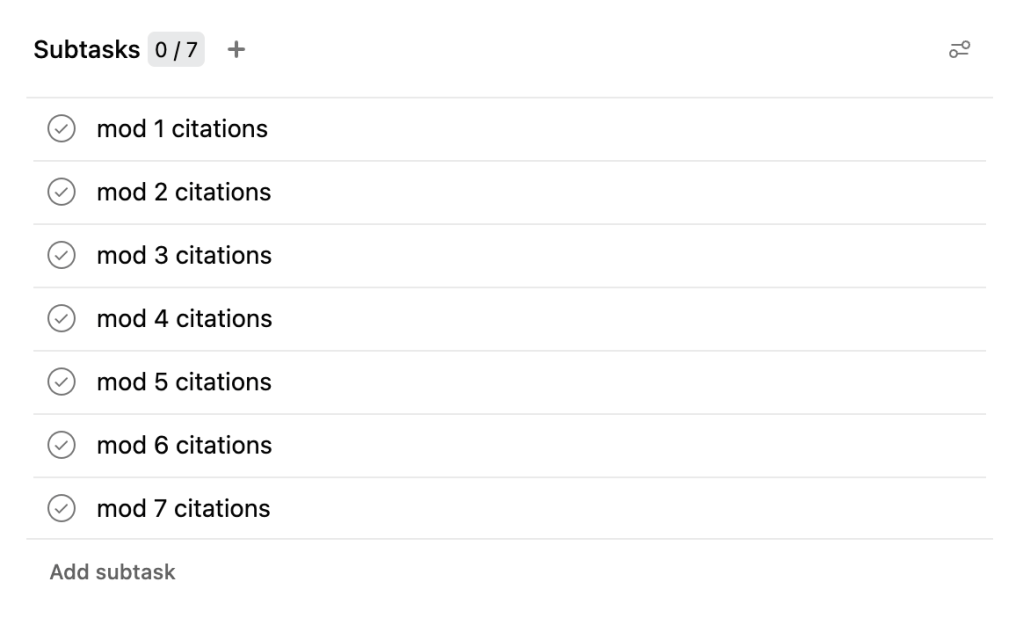
So I mapped out DCCS501 into weekly modules, divided into individual tasks, occasionally with supporting subtasks – things to check-off and keep me going strong.
Example A:
I receive satisfaction and motivation from taking a pen, or click of a mouse, to a task on a list and marking it complete. Knowing those preferences allowed me to create a system that would evoke that sense of motivation and confidence to continue on, by dividing all my tasks into smaller, easily completable, tasks.
Example B:
In the final Annotated Bibliography assignment, I need to cite all the resources I used – internal readings or viewings, external research articles, individual chapters and quotes from the foundational work, Stolen Focus, and everything else I came across that supported my work on attention and deep focus.
I broke that assignment down into subtasks based on each module’s citations. So, each time I complete a module’s citations and commentary, I can move 14% closer to achieving my overarching goal.
Tips & Tricks on Succeeding
Not everything that works for me will work for you.
Try different tools. Asana worked best for me because of my experience and comfortability with the software, but other great options are: Trello, Notion, and Monday.
Work smarter not harder. Consider your abilities, control your calendar, look for mentors and mentees to learn from.
Find a system that works for you. Take inspiration from those around you but don’t feel disappointed or embarrassed if what works for you isn’t the standard.
Implementing just one of these ideas or tools into your work system can make a huge difference!
Cruel optimism is defined by Johann Hari, author of Stolen Focus, as: “when you take a really big problem with deep causes in our culture – obesity, or depression, or addiction – and you offer people, in upbeat language, a simplistic individual solution. It sounds optimistic, because you are telling them that the problem can be solved, and soon – but it is, in fact, cruel, because the solution you are offering is so limited, and so blind to the deeper causes, that for most people it will fail.”
So take that and consider me telling you:
You can easily stop spending so much time on social media – just close the app!
It’s much easier said than done.
I’ve come to understand the toxic relationship between the user and the developer. The BBC’s, Hilary Andersson reports that social media developers in Silicon Valley are intentionally designing their software to keep us users hooked. Each scroll of our finger turns into a dollar in their pocket. So, this addictive nature we possess toward these platforms isn’t necessarily our fault. In previous works, I’ve reiterated that point: that it’s not necessarily our fault. To prove that, and protect ourselves from facing our own cruel optimism, believing we are the sole issue, we must consider the facts.
It’s Not Your Lack of Willpower
We tend to blame ourselves for our perceived failures. Last week, I did a digital detox, and it didn’t come without a bit of failure. Every time I attempted to open TikTok during the detox period, I hadn’t even realized what I was doing, as if it was a trained response. I felt terrible and undisciplined about my perceived lack of strength. What I wasn’t considering was that the app was designed for me to be drawn back, and drawn back unwillingly. Paul Lewis, of the Guardian’s ‘Our minds can be hijacked’: the tech insiders who fear a smartphone dystopia, quotes Nir Eyal, author of Hooked: How to Build Habit-Forming Products, “none of this is an accident. It is all ‘just as their designers intended.’”
There is a fundamental clash between interests that causes this unbalance. Tech companies want to keep you engaged, and by keeping you on their platform, they collect more data about who you are and how to sell to you. With this information, they report to third-party data buyers, sharing your information with them and building consumer profiles; in return they receive compensation.
For vs. Against You
Social media has the ability to be for you, to understand your intentions and help you better yourself. It could have built-in features that limit your daily use or connect you to friends nearby, in the actual world, but instead, it grabs your attention and holds you hostage. As said, more shares, clicks, and stares at the screen generate more time online and another dime in their pockets. Under a system that benefits the money makers, the structure will never change, even when they’re aware of how it hurts us. So, they feed us false optimism to divert the attention away from their unethical practices.
“It’s the twenty-first century version of Marie Antoinette saying, ‘Let them eat cake.’ Let them be present.”
Every revolutionary movement or policy change starts with one person. The idea isn’t to fight against yourself as an individual. Remember, you are one small piece of a bigger puzzle. We should strive to understand the forces working against us, collectively, rather than continuing to blame ourselves for being affected by them. We can’t be cruel to ourselves for trying, and we can’t deliver false optimism as a source of comfort when reflecting on our addictions.
If we want to reclaim our attention, we have to start being truly optimistic for our future, and begin believing in ourselves to make a change.
I asked ten people I know if they could complete a five-day digital detox. The rules were simple: spend five consecutive days abstaining from your most-used digital platform. Only three of them said they could.
So, last week, I spent five days detoxing from TikTok in the pursuit of better understanding my relationship with social media, scrolling, and deep focus.
The Experiment
The experiment consisted of recording numerical data through screen time tracking methods and noticeable mood changes, sleep score levels, changes in focus, and overall results from my TikTok abstinence. But before I began this experiment, I needed to collect baseline data for comparison. Before the detox, my daily average time spent on TikTok was 1 hour and 37 minutes a day with an overall average screen time of 4 hours and 56 minutes a day. Harmony Healthcare It reports that the average American spends 5 hours and 16 minutes a day on their phones. Scarily enough, I was right on target with the average person, so my experience and results may be relatable for most.
I wish I could say my experiment had gone perfectly, but by the first morning I had already relapsed. I instinctively opened TikTok as part of my routine morning scroll. It took 46 seconds to realize what I was doing before closing the app. Now imagine if that had been a life or death situation. If it took me 46 entire seconds to process what I was doing, would I have lived to scroll another day?
What I Noticed
As the days passed the detox felt easier. I was experiencing less impulses to scroll and feeling more mental clarity. I paid greater attention to the time I spent on social media and I began noticing the world around me more clearly.
Everyone was always on their phone.
Waiting in line, scrolling. Eating lunch with friends, scrolling. Walking to the car, scrolling. Eyes were constantly glued to phones. If an entire circus had passed by, making no noise, no one would notice.
I’m not oblivious or in denial. I know we’re experiencing a collective digital addiction that is killing our ability to socialize, create, and think, core parts of our humanity. I just didn’t realize how much I fed into it.
Reclaiming Our Attention
We value fast, dynamic, endless content in a constant stream tailored perfectly to our interests. Social media responds by building platforms and customizing features to capture, and keep, our attention.
When did we begin to value short form content more, and was it actually our choice?
A key argument in Johann Hari’s book, Stolen Focus, is that it’s not necessarily our fault, a theme I keep returning to. The minds running Silicon Valley are hijacking our attention for profit. These companies intentionally design apps, content, and features to keep you looking for what’s next. “It’s not your fault you can’t focus. It’s by design. Your distraction is their fuel.”
Your inability to put down the phone isn’t simply because you aren’t disciplined. Social media is designed to capture your attention, and with each scroll of a finger, a Silicon Valley designer gets another dollar in their pocket.
Data Insights:
Let’s back track for a moment. The baseline data collected tells a lot:
1 hour and 37 minutes spent scrolling on TikTok.
That’s:
97 minutes every day
48.5 hours every month
582 hours a year
24.25 days a year
That’s horrifying.
Nearly an entire month of every year I’ve spent watching 15 second videos that I can’t even remember the next day. The worst part is that I wasn’t actively choosing to give TikTok that much of my time, I just got pulled in and couldn’t escape, a feeling many of us can relate to.
Liz Leatrice, author of The Year Is 2063, and You Were Never Interesting, reminds us: “You have a portal in your pocket full of apps that are designed within an inch of their lives to take the best of you – your attention, your ability to focus, your time.”
We are wasting away our lives. We have to break the cycle.
Make A Change
What these digital designers don’t want you to know is that you can reclaim your focus.
It starts by implementing just one change.
Set screen-time restrictions or reminders that prompt you to think about how you are choosing to spend your free time. Do a digital detox for a day, a week, or a month. Practice screen-less activities, things that require you to think and use your hands.
In the end, my detox wasn’t perfect. I slipped up, I redirected free time to Instagram, and I continued to struggle with focusing and reclaiming my attention. What I took away from this experience is I implemented a change. I removed TikTok for a week to reconnect with deep focus and ended feeling positive on how to use the app for entertainment and enjoyment, all in moderation.
Liz Leatrice said, “Your feed was so full of people living lives so full you never stopped to consider yours.”
Take a step back from social media, examine your screen time, and implement a change. Take a pottery class, cook that recipe you’ve ignored for six months, or reconnect with an old friend over coffee. Because when you stop watching everyone else’s lives you start living your own.
Did it feel impossible to get through? Did your mind begin to wander – what’s for dinner tonight, did I respond to that message, when do I have time to workout? Did you give in to your impulses and pick up your phone instead?
It’s okay if you did. It’s not entirely your fault.
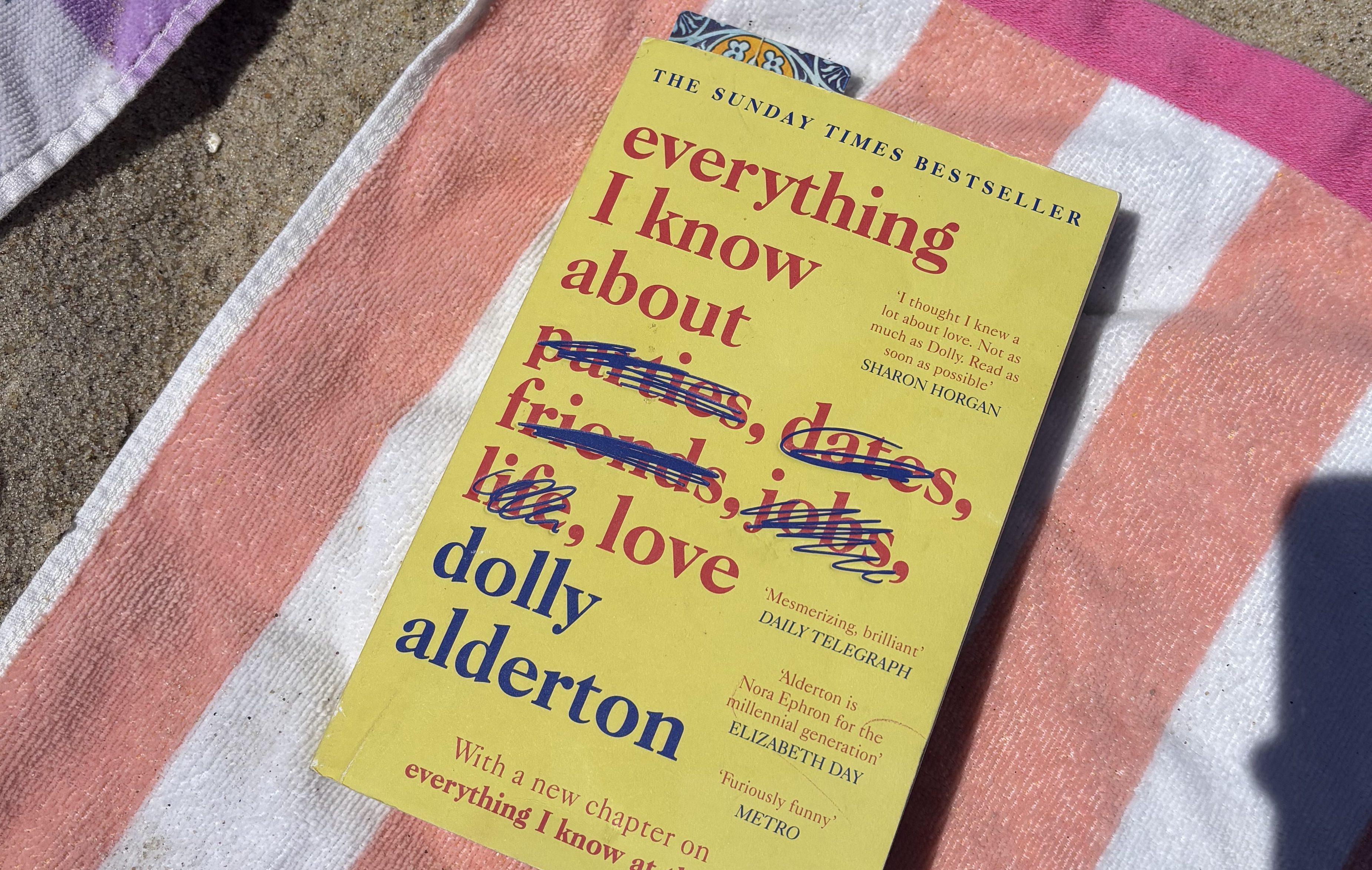
The human brain has changed. I loved to read, my favorite book being Everything I know About Loveby Dolly Alderton, a witty, honest, and emotional memoir that reflects on Dolly’s life and how her experiences shaped her idea of love. Whether it was at the beach or on the train into NYC, I loved having a different world packed into a well-loved, scratched-up paperback in my bag. The last time I finished a book was six months ago. Why is that?
With today’s digital landscape and constant noise, our brains have adjusted to all the quick, mindless content we consume, changing how we focus and what we choose to consume. According to an American Time Use Survey, referenced in Stolen Focus, around 57% of Americans now do not read a single book in a typical year. All this short-form content consumption, paired with the lack of long-form content consumption, is creating an inability to focus and it isn’t just changing what we consume, but how we think.
Reading = Empathy
Tackling an entire book, a couple hundred pages of rich plot and characterization, is a commitment. To sit with an understand a work for that long requires total and utter concentration. Not only does reading improve our focus, but it also surprisingly improves our empathy.
Johann Hari, author of Stolen Focus, describes fiction as “a kind of empathy gym,” arguing that it is one of the richest forms of focus we have. As we read, we follow a story, but we are also inside a character’s head, experiencing their thoughts and emotions. Over the duration of a book, we learn to understand them and their actions without being quick to judge, increasing our empathy.
Yet, short-form and screen-oriented reading habits push the opposite of that. Michael Harris, writer behind I’ve Forgotten How to Read, testifies, “Book-oriented styles of reading opened the world to me – by closing it. And new, screen-oriented styles of reading seem to have the opposite effect: They close the world to me, by opening it.” Digital life breeds a different style of reading, one that makes us cynical and judgmental. Another video, comment, or notification is waiting for us – all we have to do is feed into it. With an endless stream of content and information that is begging to be consumed, our attention becomes fragmented, never solely focused on one thing, and always looking for the next ‘experience’.
What Does This Do to Empathy?
A fractured attention is greater concern than a focus issue.
Hari writes, “If you see the world in fragments, your empathy often doesn’t kick in, in the way that it does when you engage with something in a sustained, focused way.” That is exactly what social media does. If you watch a 15-second video stating a controversial opinion and open the comment section, everyone has already jumped to add their own opinion, without reading into the context. All within 15 seconds. It’s ironic, because when those 15 seconds are over, you scroll, and 15 seconds later, you’ve forgotten about it entirely.
Social media doesn’t necessarily make us rude, cruel, or less empathetic. As we know, social media was designed for connecting us. The concern is when our attention is fragmented and scattered, we stop taking time to understand and process what we are seeing before forming and voicing an opinion.
Boredom Isn’t the Issue
CNN’s Madeline Holcombe’s piece, The boredom scroll on socials may be making your problem worse, study says, made me consider my relationship with my social media. In the slightest moment of boredom, I reach for it, for comfort and stimulation. Waiting in line? Scroll. Commercial break? Scroll. Walking to class? Scroll.
Boredom isn’t a bad emotion; it’s natural, and you should allow yourself to feel it.
Dr. Katy Tam, referenced in Stolen Focus, explains that “enjoyment often comes from engaging with the content rather than swiping through it.” Our society pushes constant consumption, to the point that sitting with one thing can feel boring or tiring.
Let Your Mind Wander
Surprisingly, mind-wandering is beneficial for thinking.
Hari points out that when you look back at technological or scientific breakthroughs, “many of those great breakthroughs didn’t happen in a period of focus, they happened during mind wandering.” When you take a step back from an intense focus and float through your mind, you’ll be surprised what you find.
Many of us face obsessions with constant productivity, I know I do, and it restricts me from ‘wasting time’ and truly allowing my mind to wander. David Robson of the Guardian comments on flow, that flow similarly explains that we reach flow when we find the right balance between our abilities and the challenge in front of us.
What are we losing and how do we stop it?
Constant scrolling doesn’t mean we forget how to read or finish a book.
It does imply that we are losing our ability to sit long enough with a text, work, or idea to truly understand it. If we can’t process a work that consumes more than 30 seconds of our time, how are we going to understand each other’s complex emotions – a fundamental point of humanity and community?
Hari writes, “Every time you widen human empathy, you open the universe a little more.”
Widening our universe, and the collective universe, starts by picking up a book.
We scroll because we’re overstimulated, but we become even more overstimulated because we keep scrolling.
Why does it feel impossible to find a balance?
Short-form videos and tailored content have changed how we engage with, and pay attention to media, altering our ability to focus. What began as a tool for connection and creativity has now become a digital environment built around keeping consumers constantly engaged and looking for the next big thing. Johann Hari’s, Stolen Focus addresses the attention crisis and argues that individual self-restraint can’t simply overcome the modern digital environment, especially when the system actively feeds into attention loss. Essentially, it’s not your fault you feel this way.
The Scroll Break
While working through long tasks or in between mundane personal chores, it’s easy to look for a bit of relief, often found through the scroll break.
Scroll break: taking five minutes to reward yourself after completing, or trying to complete, a task, only to spend thirty minutes scrolling through short-form content.
Incorporating scrolling into your ongoing task isn’t “doing two things at once.” It often makes it more difficult to maintain focus and mental clarity. According to Hartford Healthcare, multitasking is widely accepted as a skill when, in reality, it is often task-switching. So, every time we step away from our responsibilities to swipe through social media, our brains have to redirect their attention back to the task. So that five-minute scroll break, which is never actually five minutes, can do the opposite of what you intended it to do. When we need rest, we are filling that time with more stimulation. Revere Health states that heavy interaction with short-form content has also been linked to weaker attention and reduced focus.
So, constant stimulation is making it harder to maintain our attention. No surprise there.
The Stimulation Cycle
Social media’s addictive nature paired with quick, tailored content creates an space that is difficult to leave. Content is designed to be fast, entertaining, and rewarding with an endless supply of ‘what’s next?’ offered at our disposal.
Let’s consider the science behind it: short-form videos give the brain frequent bursts of dopamine, the chemical that supports reward and motivation in the brain.
Speed, novelty, and personalization are characteristics of short-form content that reinforce reward-seeking behavior.
When we become used to endless, fast-paced stimulations, slower activities feel less immediately rewarding, leading to attention loss. It’s not rewarding to finish an assignment or task in that way it used to be.
Caught in the Algorithm
The attention crisis becomes understandable when we analyze the systems behind the content. These social media platforms are designed to understand what keeps us engaged, and they continually adapt to that information, ergo, the algorithm.
Media now is shaped by immediacy, personalization, accessibility, and algorithmic discovery. PwC’s report notes that “80% of Netflix viewing is driven by algorithmic recommendations.” So, recommendation algorithms determine what gets viewed and shapes what is produced.
Even when we try to return to long-form content, it’s being shaped by short-form content standards. It’s inescapable
Algorithm-based platforms learn from how we interact with content and use that information to determine what’s coming next. Then audience behaviors inform how companies choose to invest and what to produce. Recommendation systems are not just determining what gets viewed; they are determining what gets made, and, ultimately, what shows up on our screens.
We engage with fast-paced content that captures our attention, algorithms learn what to offer, platforms push more of it, creators adapt to what performs well, and as a result we become accustomed to an even faster pace.
We feed the algorithm, and it feeds us back.
Reclaim Your Attention
Social media and short-form content are not the villain.
They offer tools of communication, creativity, connection, and education. To appreciate these platforms without becoming dependent on them, we need to become more intentional with our consumption and engagement. But that doesn’t mean blame yourself!
Be mindful of your consumption. Take a true rest break, not a scroll break that doesn’t actually refresh and realign your mind with the task at hand.
Frequently take steps away from the digital landscape. Reconnect with traditional media. Try staring at a painting for 10 minutes. Check out the NYT experiment – challenge yourself.
Consume less and create more! Formulate ideas, create, and execute. Follow through! Don’t give in after five minutes because you’re uncomfortable and want to scroll.
As you know, it’s not completely your fault your attention span has changed. We can’t control the digital environment and the direction it’s headed, but we can become more aware of how it is shaping us.
As Hari emphasizes in Stolen Focus, reclaiming our attention isn’t a simple matter of individual discipline. It requires recognizing how the environment around us is shaping what we do, how we engage, and what we are capable of focusing on.